Read the canopy
We look at the whole tree first: deadwood, weak forks, limbs over targets, and how balanced the crown is after the strong summer growth our climate produces.
Tree trimming and pruning in Augusta, GA. Proper cuts for clearance, structure, and storm resistance on oaks, pines, and crape myrtles.
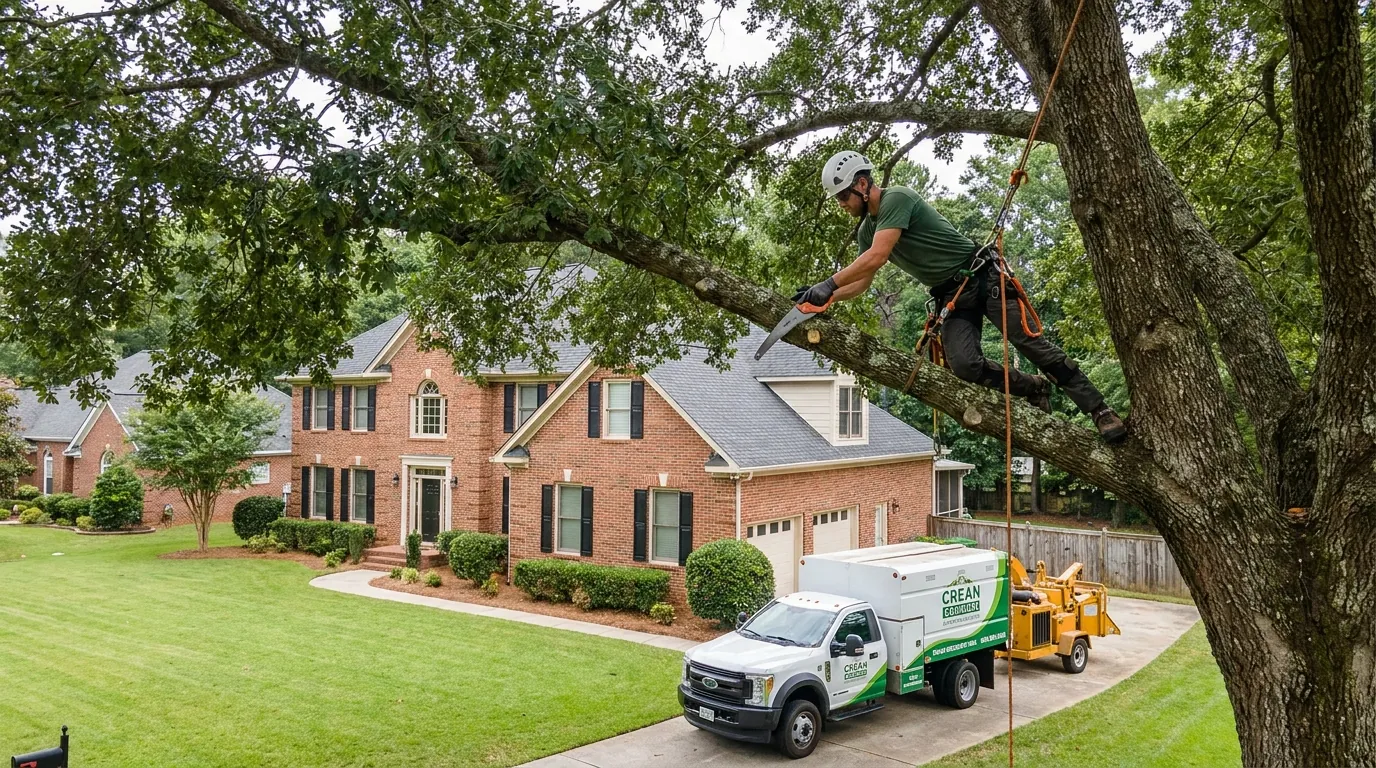
Tree trimming is often confused with simply cutting a tree back. Done well, it does three things: removes deadwood and weak limbs before they fall, lifts the canopy off roofs, driveways, and service lines, and reduces end-weight on long limbs so they bend less in wind. In Augusta, where summer thunderstorms arrive fast and heavy, that last point matters — over-extended limbs on water oaks and pines are a common failure point.
People searching for tree trimming near me often have a specific nuisance in mind: a limb over the garage, branches brushing the house, or a crape myrtle that's gotten unruly. Those are all legitimate, but the best pruning also looks at the whole tree's structure. If a tree has deeper problems than its branches, trimming won't fix it — that's when a tree health assessment or tree removal is the right conversation.
The goal is always the fewest, best-placed cuts — over-trimming does more harm than good.
We look at the whole tree first: deadwood, weak forks, limbs over targets, and how balanced the crown is after the strong summer growth our climate produces.
Deadwood removal and clearance over roofs, driveways, and service lines come first, followed by thinning and reducing over-extended limbs.
Cuts are made at the branch collar so the tree can seal them — important in Augusta's humidity, where sloppy cuts invite decay fungi.
Brush is chipped and hauled, and we leave the canopy balanced rather than stripped.
Augusta's long, humid growing season means trees put on a lot of growth, and that growth adds weight and sail area that storms can catch. Dormant-season pruning, in late winter, is usually easiest on hardwoods and lets us see structure clearly without leaves. Light clearance and deadwood work can be done any time of year.
A common local mistake is topping — cutting large limbs back to stubs. In our humid air, those wounds rarely seal and often rot, and the tree responds with weak, fast-growing shoots that are more hazardous than what was removed. We prune to reduce and shape without topping, which keeps the tree sound and storm-ready for longer.
Call Augusta Tree Team to schedule trimming. We'll look at the whole tree, not just the limb that caught your eye.
Serving Augusta and the surrounding area.
Late winter, while hardwoods are dormant, is ideal for structural pruning because the branches are bare and the tree seals cuts well as it wakes up. Deadwood removal and clearance pruning can be done at any time of year as needs arise.
As a rule we avoid taking more than about a quarter of a tree's live canopy in a single season. Removing too much stresses the tree and triggers weak regrowth, which is the opposite of what good pruning should accomplish.
Sometimes reducing weight helps a borderline tree, but trimming can't repair root damage, trunk decay, or a structural lean. If those are present, an assessment or removal is the safer path, and we'll say so.
We handle clearance pruning around service lines running to your home. Lines owned by the utility along the street are their responsibility, and we'll point you to them when that's the case.