Canopy and deadwood
We look for dead or dying branches, thinning foliage, and dieback at the tips, which point to stress, root trouble, or disease.
Tree health assessment in Augusta, GA. Spot decay, root problems, and failure risk before a tree comes down on its own in a storm.
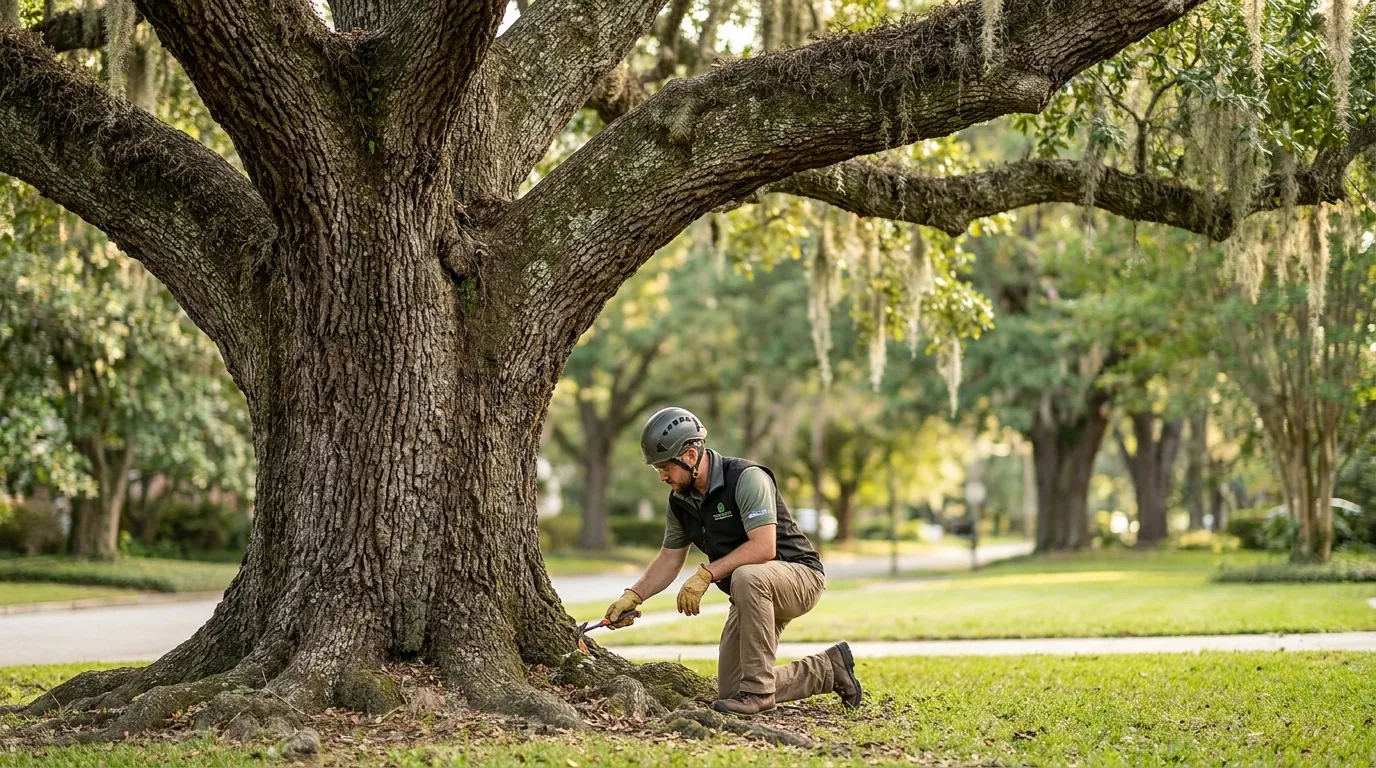
The hardest part of owning a mature tree is that its biggest risks are hidden. A water oak can look full and green while rot hollows its trunk, and a leaning pine can seem stable right up until the saturated clay around its roots lets go. A tree health assessment is a deliberate, close look at a tree to answer the questions that matter: Is it sound? Can a problem be managed? Or has it become a risk worth acting on?
An assessment is the honest first step before bigger decisions. It can confirm that a worrying tree is fine and just needs tree trimming, or it can make the case that tree removal is the safer call. Either way, you're deciding on evidence instead of a guess.
A good assessment moves from the top of the tree down to the roots and the soil it stands in.
We look for dead or dying branches, thinning foliage, and dieback at the tips, which point to stress, root trouble, or disease.
Cavities, seams, bulges, included bark at forks, and conks or mushrooms on the stem all tell us about internal strength.
We check for soil heaving, girdling roots, cut or paved-over roots, and decay at the root flare — common failure points in wet clay.
We weigh what the tree could hit if it failed — house, line, drive — because risk is about both condition and consequences.
Augusta's humidity and warm season feed the decay fungi that hollow out mature hardwoods, and the fruiting bodies — mushrooms and shelf-like conks at the base or on the trunk — are often the only outward sign of serious internal rot. Spotting them early changes everything about your options.
Red clay adds the root-side risk. Because it drains slowly, trees here can develop shallow or compromised root systems that fail in saturated soil during storms. A tree may show no canopy problems at all and still be at risk from below. Assessing both the tree and the ground it stands in is the only way to judge the real picture — and the best time to do it is before storm season, not during it. If a tree has already failed, that's a job for emergency tree service.
Call Augusta Tree Team for a straight assessment. We'll tell you whether it's sound, treatable, or a risk — and what we'd do about it.
Serving Augusta and the surrounding area.
Watch for mushrooms or shelf-like conks at the base or on the trunk, cracks or seams in the stem, a lean that's getting worse, soil heaving on one side of the base, and large deadwood in the canopy. Any of these is reason for a closer look.
Often, yes. Many trees that look alarming are structurally sound and just need deadwood removed or weight reduced. An assessment separates cosmetic problems from genuine hazards so you don't remove a tree that could have been kept.
Before storm season is ideal, so you can act on any problems on your own schedule rather than in an emergency. That said, any time you notice a change in a tree — a new lean, dieback, or fungi — is a good time to have it checked.
Yes. We assess any tree on your property regardless of its history. We're looking at its current condition and the soil and site around it, not at who cared for it before.