When removal is the right call

Not every troubled tree needs to come out, but some do — and in Augusta the deciding factors are usually root condition, decay in the trunk, and how close the tree stands to your house, driveway, or a power line. A tree that leans more each season, drops large limbs without wind, or shows soil heaving at its base is telling you something. On our red clay soils, which hold water for days after a storm, root plates loosen and large pines and oaks can lean or uproot even in moderate wind.

Searching for tree removal near me usually starts after one of those warning signs. The honest answer isn't always removal — sometimes a problem is solved with targeted tree trimming or confirmed with a tree health assessment. But when the structure of a tree is compromised over a target, taking it down is the safer, cheaper decision in the long run.
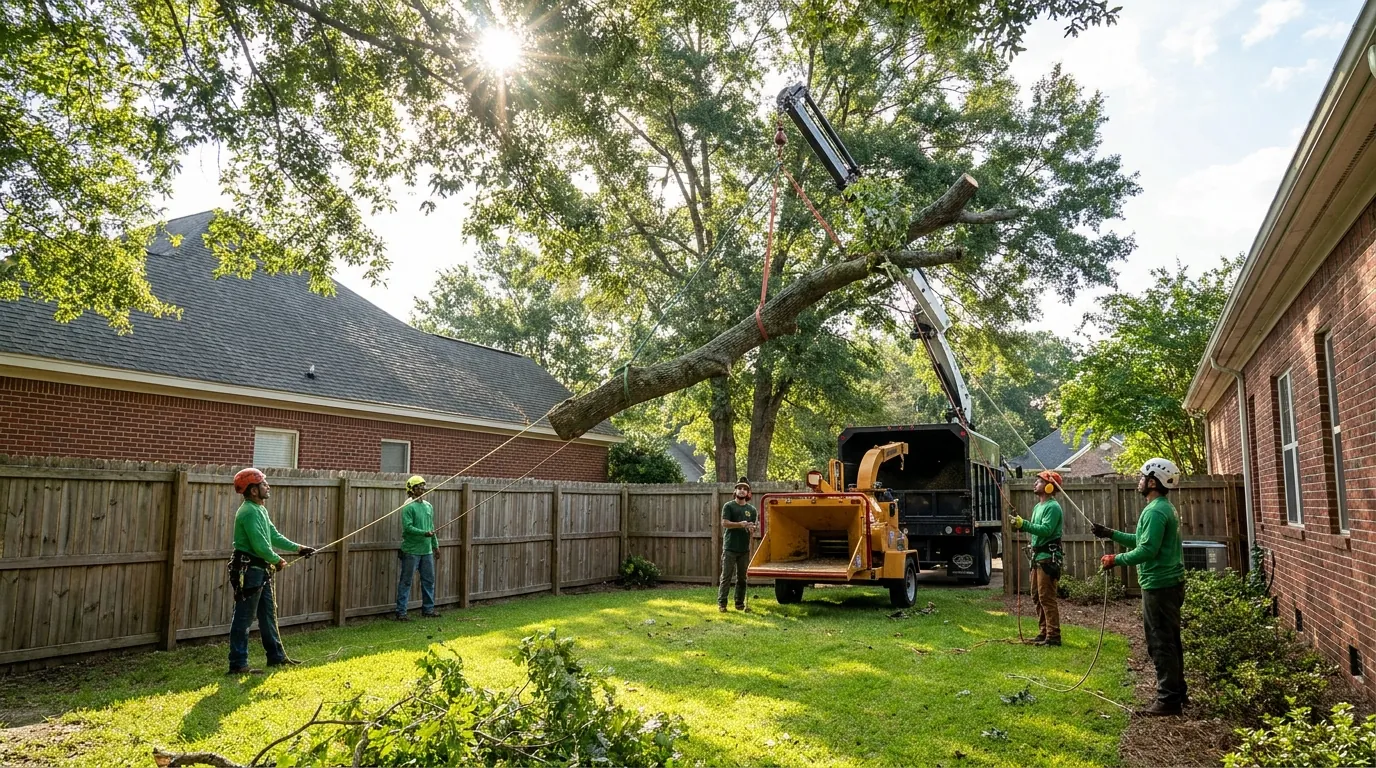
What the work involves, step by step

Every removal is planned around the target zone — what sits under and around the tree — not just the tree itself.

Assessment and plan

We walk the site, judge lean, decay, and root condition, and map where sections can fall or be lowered. Tight Augusta lots and overhead utility lines usually dictate whether a tree comes down in one drop or is climbed and dismantled piece by piece.

Site protection

We clear and protect the drop zone — moving vehicles, covering fragile beds, and setting up for a controlled lowering over roofs, fences, or neighboring yards.

Sectional removal or felling

Where there is room, a tree may be felled whole. Near structures, a climber or lift removes it in sections, roping larger limbs down rather than dropping them.

Cleanup and haul-off

Brush is chipped, logs are cut to manageable lengths, and debris is removed. What remains is the stump, which can be handled with stump grinding.

How Augusta soil and climate change the job

Augusta's humid summers and red clay soils shape nearly every removal. Clay drains slowly, so after heavy rain the ground around a tree stays saturated and soft — a tree that felt solid in July can heave or lean in a wet February. Saturated ground also means heavy equipment can rut a yard, so timing and ground protection matter.

Humidity drives decay. Water oaks, laurel oaks, and large pines are common here and all tend toward internal rot and sudden limb drop as they age. A trunk that looks fine on the outside can be hollow, which is why we read lean, deadwood, and base condition together rather than trusting bark alone. Storm season adds the sharpest risk — if a tree has already failed, see our emergency tree service.

Not sure if it has to come down?

Call Augusta Tree Team to have the tree looked at. We'll tell you honestly whether removal, trimming, or monitoring is the right next step.

Serving Augusta and the surrounding area.

Frequently asked questions

How do I know a tree needs to be removed instead of trimmed?

Trimming solves branch problems — deadwood, clearance, and weight. Removal is for problems in the trunk or roots: significant decay, a worsening lean, root damage, or heaving soil at the base. A health assessment can confirm which situation you're in before anything is cut.

What drives the cost of a tree removal in Augusta?

Size and species, how close the tree is to your house or power lines, whether it can be felled whole or must be dismantled from above, and access for equipment are the main factors. A big water oak overhanging a roof costs far more than the same tree in an open field because of the care required.

Will removal tear up my yard?

On wet clay it can, which is why we watch timing and use ground protection where needed. Dismantling a tree in sections and chipping debris on site keeps traffic and ruts to a minimum compared to dragging whole trees across a lawn.

Do you take the stump too?

Removal leaves the stump at ground level unless you add stump grinding, which reduces it below grade so you can replant or lay sod. Many homeowners schedule both at once.