A new or worsening lean
A tree that has started leaning after a storm — especially with soil heaved or cracked on the high side of the root plate — may be losing its anchorage in wet clay. A sudden lean is more urgent than a lean the tree grew with.
Tree removal service in Augusta, GA. Learn the warning signs, how removal is done step by step, and how red clay soil and humid summers change the job.
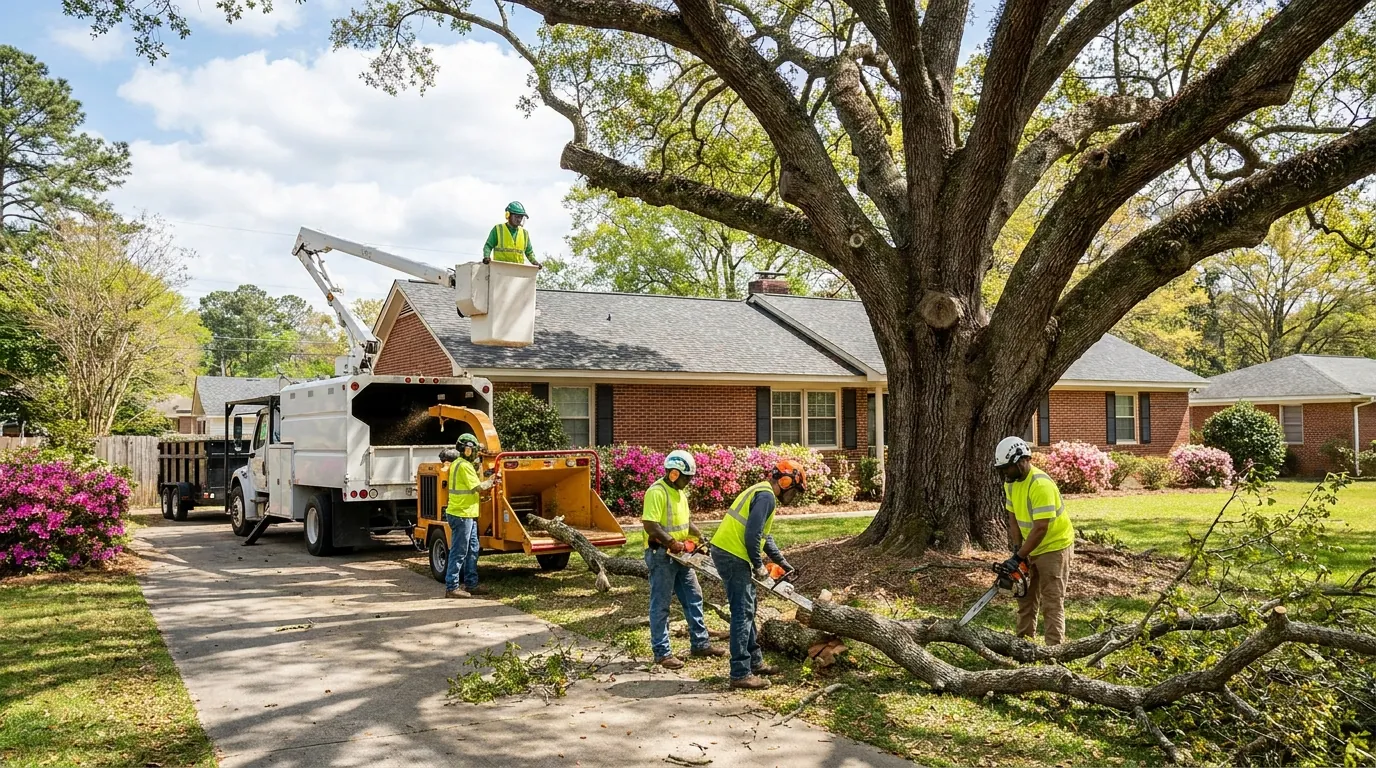
Not every tree that worries a homeowner needs removal, but some do — and in Augusta the deciding factors are usually the same handful of issues. Loblolly and longleaf pines that have grown tall and top-heavy can lean toward a roof after a wet season loosens their footing in the red clay. Water oaks and willow oaks, common in older Augusta neighborhoods, are fast-growing but weak-wooded, and mature ones often drop large limbs or split at the trunk. When a tree threatens a structure, is already dead, or is decayed at the base, removal becomes the safe choice. If you searched for a tree service near me because a tree is looming over the house, the first step is an honest look at whether it truly has to go.
This page explains what a real tree removal service involves — how the tree is assessed, how it is taken down in sections when there is no room to drop it, and what happens to the stump and debris afterward. It also covers how our local soil, heat, and storm patterns change the work. If your tree is damaged but salvageable, you may instead want tree removal repair, which focuses on saving a tree through cabling, pruning, and cleanup rather than taking it out.
Every removal is different. A slender pine in an open yard is a straightforward job; a 60-foot water oak wedged between a house and a power drop is a rigging problem that has to be solved piece by piece. The goal is always the same: get the tree down without damaging anything you want to keep.
A few clear symptoms tell you a tree has moved from healthy to hazardous. Any one of these is worth a closer look.
A tree that has started leaning after a storm — especially with soil heaved or cracked on the high side of the root plate — may be losing its anchorage in wet clay. A sudden lean is more urgent than a lean the tree grew with.
Large dead branches, or a canopy that leafs out thin and late in spring, point to decline. Deadwood over a driveway, deck, or roof is a falling hazard even before the whole tree fails.
Vertical trunk cracks, hollow spots, or shelf fungus at the base signal internal decay. Mushrooms growing from the root flare often mean the roots are already rotting where you can't see.
A trunk within a few feet of the foundation, or heaving roots lifting a walkway, can force removal even on an otherwise healthy tree when it can no longer be managed by pruning.
A controlled removal follows a clear sequence. The right approach depends on the space around the tree and what sits below it.
We look at the tree's lean, condition, and what surrounds it — the house, fences, power lines, gardens. That determines whether the tree can be felled in one piece or must be dismantled from the top down.
In an open yard, a tree may be felled whole into a clear landing zone. In a tight Augusta lot, a climber or lift works down the tree, roping limbs and trunk sections so nothing free-falls onto what's below.
Branches come off first, then the trunk is cut in manageable lengths and lowered under control. This is slower than dropping a tree but is the only safe method near structures and utilities.
Once the tree is down, wood is bucked and hauled or chipped, and the stump is ground below grade if you want the spot reclaimed. We rake the area so you're not left with a mess of chips and bark.
Augusta's humid summers and red clay soils shape tree removal in ways that matter. Clay holds water and drains slowly, so after a stretch of heavy rain the ground around a big tree softens and a leaning tree can shift or uproot with little warning — this is when we see the most urgent calls. The same clay makes stump grinding heavier work, because the roots grip densely packed soil.
Heat is a scheduling factor too. Working a full canopy in July humidity is hard on a crew and slows a job down, so larger removals are often planned for the cooler parts of the day. Storm season brings sudden hazard trees — pines snapped or leaning after a summer thunderstorm — that jump the queue ahead of routine work. If a tree is on the fence between removal and saving, tree removal repair may be the better first conversation, and once a tree is gone you may want to plan a replacement through tree removal installation.
It depends on the extent of decay and how close the tree is to something it could damage. A tree with a solid trunk and limited deadwood can often be pruned and kept, while one that is dead, hollow, or leaning from failed roots usually needs to come out. We give you an honest read either way.
When there's no room to fell a tree whole, a climber or lift works it down in pieces, roping each limb and trunk section so it's lowered under control instead of dropping. It takes longer than a straight fell but keeps roofs, fences, and lines intact.
The main drivers are the tree's size, its condition, how tight the access is, and whether power lines or structures are close by. Adding stump grinding and hauling the wood off also changes the total. We can walk the site and explain what's driving the number before any work starts.
Stump grinding is a separate step you can add. Some homeowners keep a low-cut stump; others want the spot ground below grade so they can replant grass or a new tree. We'll tell you what's involved for your particular stump and root spread.
Call to describe the problem and get a quote for work in Augusta, GA.