Mature size and placement
Plan around how big the tree gets, not how big it is now. Keep large shade trees well away from the house, septic lines, and overhead wires, and use smaller ornamentals close to structures.
Tree installation and replacement in Augusta, GA. Choosing and planting the right tree for red clay soil and humid summers after a removal.
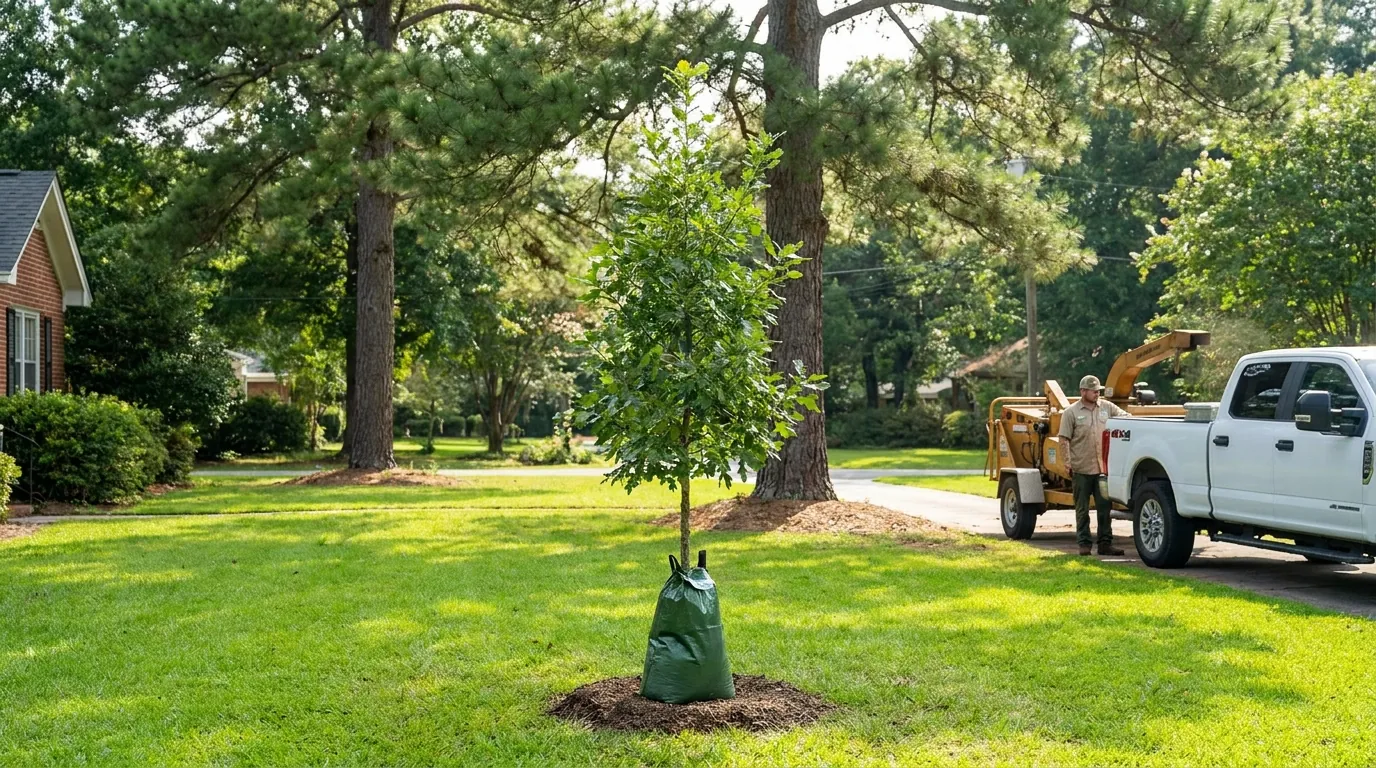
Taking a tree out often leaves a bare, sunny spot and a question: what should go there now? Tree installation is the planting side of the job — choosing a species that fits the site, placing it where it won't fight the house or the power lines in twenty years, and getting it in the ground so it establishes properly. It's the natural follow-up to a tree removal service, and doing it thoughtfully avoids repeating the problem that led to the removal in the first place.
The most common Augusta mistake is planting a large-growing shade tree too close to a foundation, a driveway, or an overhead line. A water oak that looks manageable as a sapling becomes a 60-foot tree with heaving roots. Good installation starts with matching the mature size of the tree to the space you actually have, then thinking about soil, drainage, and sun.
This page covers how to pick a replacement, how planting is done in our heavy clay, and what a young tree needs through its first couple of Augusta summers to take hold.
A good replacement tree is a match for the spot, not just a tree you like. These are the factors that matter most here.
Plan around how big the tree gets, not how big it is now. Keep large shade trees well away from the house, septic lines, and overhead wires, and use smaller ornamentals close to structures.
Augusta's red clay drains slowly. Species that tolerate periodically wet, heavy soil establish far better here than those that need fast-draining ground, so soil tolerance drives a lot of the choice.
An open spot where a big tree used to stand is now full sun through a brutal summer. The replacement needs to handle that exposure while it's young and hasn't grown its own canopy yet.
Some fast-growing trees lift walkways and clog lines. Choosing a tree with a better-behaved root habit near paving and pipes saves you a future removal.
Getting a young tree established in clay is mostly about the hole, the depth, and the first season of care.
We look at drainage, sun, and what's above and below ground before choosing a spot. In heavy clay, we check how water sits after rain, since a poorly drained hole can drown new roots.
The planting hole is dug wide and no deeper than the root ball, with the sides roughened so roots can push into the surrounding clay instead of circling in a slick-walled pit.
The root flare stays at or just above grade — planting too deep is a leading cause of young-tree decline in clay soils that hold moisture around the trunk.
A ring of mulch, kept off the trunk, holds moisture and moderates soil temperature. We'll leave you a simple watering schedule for the first summer, which is when a new Augusta tree is most at risk.
Red clay is the defining factor. It holds nutrients well but drains slowly, so a hole that fills with water after a storm can suffocate new roots — which is why depth, drainage, and species choice all revolve around the clay. A tree that thrives in sandy coastal soil may struggle here, and one native or adapted to the Piedmont's heavy ground will settle in far more easily.
Timing matters too. The kindest window to plant is the cooler part of the year, when a young tree can grow roots before facing a full Augusta summer. A tree planted in July faces heat and drought stress before it's established, so it needs much more careful watering. If you're planting because a hazard tree came out, it's worth revisiting what failed — and if a nearby tree is damaged rather than dead, tree removal repair may let you keep it while the new one grows in.
The cooler months are ideal, because a young tree can put down roots before it has to survive a hot, dry summer. Planting in mid-summer is possible but demands close attention to watering while the tree establishes.
It depends on the tree's mature size — a large shade tree should be well clear of the foundation, driveway, and overhead lines, while a small ornamental can sit closer. Planning around the full-grown tree, not the sapling, prevents a future removal.
Augusta's red clay drains slowly, so a poorly dug or too-deep hole can trap water around the roots and drown a new tree. Choosing a clay-tolerant species and setting the root flare at the right height are the biggest factors in whether it survives.
Through the first summer a new tree needs steady, deep watering rather than frequent light sprinkles, so moisture reaches the root ball. We'll leave you a simple schedule to follow, adjusted for how well your site drains.
Call to describe the problem and get a quote for work in Augusta, GA.