Broken and hanging limbs
After a storm, torn and partially attached branches are the most immediate danger. Cutting them back cleanly to the branch collar removes the falling hazard and lets the wound close properly instead of tearing further.
Storm and damage tree repair in Augusta, GA. When a tree can be saved with pruning and cabling, and when cleanup and removal make more sense.
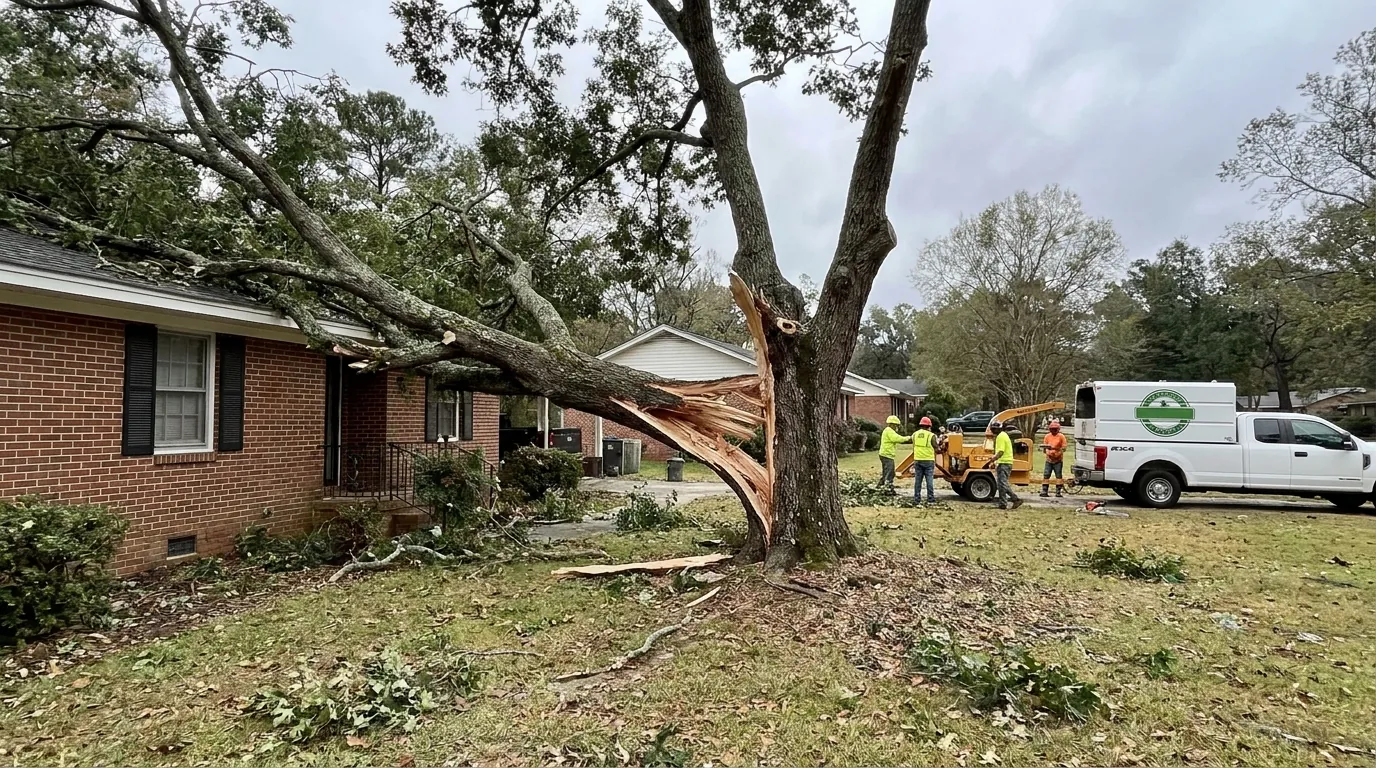
A storm rolls through Augusta, a limb tears off a water oak, and the first instinct is to take the whole tree out. Often that isn't necessary. Many damaged trees can be repaired — pruned back to sound wood, cabled to support a weak union, and cleaned up so they recover instead of being removed. This page covers what tree repair actually involves, how to tell a repairable tree from one that's past saving, and how our local conditions figure into the decision.
Repair work sits between routine trimming and full removal. It's for trees that have been hurt but still have a healthy structure to build on: a split limb that can be cleanly cut, a cracked co-dominant stem that can be braced, or a canopy full of hanging broken branches after a thunderstorm. If the trunk is shattered or the tree is uprooted, repair isn't realistic and tree removal service is the safe path instead.
The aim of repair is to reduce risk and give a tree the best chance to heal — not to promise it will survive. No one can promise a stressed tree will pull through, but sound pruning and support give a healthy tree its best odds.
Repair covers the range of damage that leaves a tree standing but compromised.
After a storm, torn and partially attached branches are the most immediate danger. Cutting them back cleanly to the branch collar removes the falling hazard and lets the wound close properly instead of tearing further.
Water oaks and other fast-growing Augusta trees often form V-shaped forks that split under wind or ice. A cracked but stable union can sometimes be supported with cabling or bracing to relieve the load.
Removing deadwood and reducing a heavy canopy lowers the wind load on a weakened tree, which matters during Augusta's summer storm season when gusts hit an overloaded crown hard.
Ragged breaks are trimmed to sound wood and the yard is cleared of downed limbs and brush, so the tree recovers and the site is safe to use again.
Repairing a damaged tree is a judgment call at every step. Here's the general sequence.
We look at how much of the crown and trunk is compromised. A rough rule is that a tree missing more than roughly half its canopy, or split into the main trunk, is usually a removal — less than that is often repairable.
Hangers and broken limbs come down first so the tree and the area beneath it are no longer an immediate hazard. This part often happens fast, especially after a storm.
Torn wood is cut back to a clean collar so the tree can compartmentalize the wound. We avoid over-cutting, which stresses a tree that's already trying to recover.
Where a union or leader needs help, cabling or bracing can share the load. We'll tell you what to watch for over the next season so you know whether the tree is recovering.
Our humid summers drive fast growth, which is a mixed blessing: Augusta trees put on wood quickly but often form weak forks and dense, heavy canopies that catch wind. That's exactly the structure that fails in a summer thunderstorm, so a lot of repair work here follows the same storms that also produce urgent removals. Red clay soil holds water, and a repeatedly saturated root zone can leave even a repaired tree unstable — part of assessing repair is checking that the roots still have a firm hold.
Heat and humidity also affect healing. Wounds on a stressed tree can invite decay fungi, which thrive in warm, damp conditions, so clean cuts and good timing matter more here than in a drier climate. If the assessment shows too much structural loss, the honest answer is removal through tree removal service; if you lose a tree and want to replant, tree removal installation covers choosing and placing a replacement that suits the site.
Often, yes — if the trunk is sound and the tree still holds most of its canopy, cutting the wound back cleanly gives it a good chance to recover. The concern is when the break runs into the main trunk or removes most of the crown, which usually points toward removal.
Cabling installs flexible support between limbs or stems to reduce the strain on a weak fork or a cracked union. It's used on trees worth keeping that have a structural weakness but are otherwise healthy, and it doesn't make the tree indestructible — it lowers the load.
Hanging and broken limbs should be handled quickly because they can fall without warning. The corrective pruning and support work can follow once the immediate hazard is cleared, ideally before the wound has time to dry out and tear further.
Sound repair improves a healthy tree's odds, but no one can promise a stressed tree will survive. We're honest about which trees are worth the effort and which are better removed before they fail.
Call to describe the problem and get a quote for work in Augusta, GA.